
Career in ISRO: Eligibility, Courses, Jobs & Career Opportunities
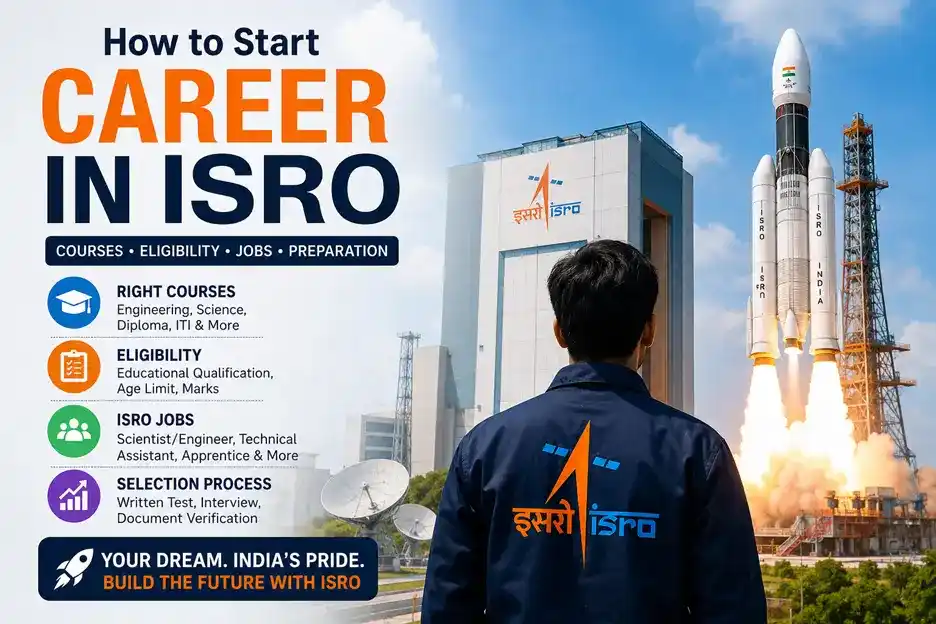
Start career in ISRO (Indian Space Research Organisation) is a dream for many students who are fascinated by Space, Satellites, Rockets, Science and Technology. To get a job in ISRO is not only about being interested in space. You need the right Educational qualification, Technical knowledge, Practical skills and in many cases, A strong performance in the recruitment process.
ISRO offers career opportunities for candidates from different educational backgrounds. Depend on your qualification, you can apply for positions such as Scientist/ Engineer, Technical Assistant, Scientific Assistant, Technician, Draughtsman, Apprentice, Research Fellow and several administrative positions.
What is Indian Space Research Organisation (ISRO)?
The Indian Space Research Organisation (ISRO) is India’s national space agency. It works on Satellite technology, Launch vehicles, Space applications, Remote sensing, Communication, Navigation and Scientific research.
ISRO operates through various centres and units across India. Career opportunities are not restricted to a single location or a single type of job.
For students, one important point is that you do not necessarily have to study aerospace engineering to work at ISRO. Depending on the recruitment notification, opportunities can be available in areas such as Electronics, Mechanical Engineering, Computer Science, Electrical Engineering, Civil Engineering, Physics, Chemistry and Mathematics, among others.
How to Start Career in ISRO?
The first step is to decide what type of ISRO career you want. Your educational qualification will largely determine which positions you can target.
A simple career path can look like this: Class 10 → Class 12 → Engineering/Science/ITI/Diploma → Relevant skills → ISRO recruitment → Selection → Career at ISRO
There are several different routes.
1. Engineering Route
For students who want to become Scientists or Engineers, pursuing a relevant engineering degree is one of the most popular routes.
You can consider courses such as:
- B.E. in Electronics and Communication Engineering.
- B.Tech in Electronics Engineering.
- B.E./B.Tech in Mechanical Engineering.
- B.E./B.Tech in Computer Science Engineering.
- B.E./B.Tech in Electrical Engineering.
- B.E./B.Tech in Civil Engineering.
- Other relevant engineering disciplines mentioned in individual recruitment notifications.
ISRO’s Scientist/Engineer recruitment has included several engineering disciplines over the years. The exact branches accepted can vary from one notification to another.
2. Science Route
Students interested in scientific research can also build careers through science-related education.
Depending on the position, relevant qualifications can include:
- Physics
- Chemistry
- Mathematics
- Computer Science
- Other specialised science subjects
ISRO’s career information specifically lists opportunities for graduates, postgraduates and doctorates in several scientific and technical fields.
3. Diploma and Technical Route
You do not always need a B.Tech or M.Tech to enter the space sector.
Candidates with a diploma or equivalent qualification may find opportunities for positions such as Technical Assistant or Scientific Assistant, depending on the recruitment notification.
Similarly, candidates with SSLC/SSC/Matriculation plus ITI/NTC/NAC qualifications may be eligible for certain Technician or Draughtsman positions.
4. Apprentice Route
Apprenticeships can be another useful way to gain practical experience in an ISRO centre.
An apprenticeship is not the same as permanent recruitment but it can provide valuable exposure to a professional technical environment.
Best Courses to Prepare for an ISRO Career
There is no single course that guarantees a job at ISRO. Instead, you should choose a course that matches the type of work you want to perform.
Engineering Courses Some commonly relevant options are given below:
| Course | Possible Career Area |
| B.Tech/B.E. Electronics | Electronics, Communication and instrumentation |
| B.Tech/B.E. Mechanical | Mechanical systems and manufacturing |
| B.Tech Computer Science | Software, Computing and information systems |
| B.Tech Electrical | Electrical systems and related engineering |
| B.Tech Civil | Civil and infrastructure-related work |
| M.Tech | Advanced technical and research roles |
| B.Sc./M.Sc. Science | Scientific and research related opportunities |
Scientist/Engineer ‘SC’ in ISRO
One of the most attractive career paths is the Scientist/Engineer ‘SC’ position.
ISRO’s career information states that Scientist/Engineer ‘SC’ recruitment can be conducted through different routes, including BE/B.Tech-based recruitment and, in some recruitment cycles, GATE based selection. The eligibility requirements depend on the specific advertisement.
Students should regularly check the official ISRO Careers page rather than depending on old recruitment information.
ISRO Scientist/Engineer Eligibility
The exact eligibility conditions vary according to the recruitment notification. However, ISRO’s published career information gives an indication of the requirements used for Scientist/Engineer ‘SC’ recruitment.
For BE/B.Tech based recruitment, ISRO has listed an engineering degree with a minimum aggregate of 65% marks or CGPA 6.84/10 and above for the relevant route. The age limit shown for this category is 28 years, although the actual notification should always be checked for the current recruitment cycle and applicable relaxations.
For certain ME/M.Tech-based recruitments, the published career information lists a minimum of 60% marks or CGPA 6.5/10 in ME/M.Tech, along with the prescribed qualifying marks in the pre eligibility degree.
Is GATE Required for ISRO?
Not always, ISRO has used different recruitment methods for Scientist/Engineer positions. Some recruitment drives have been based on GATE scores, while others have used a written test followed by an interview.
You should not assume that GATE is compulsory for every ISRO Scientist/Engineer recruitment.
If a particular notification asks for a valid GATE score, prepare seriously for GATE in your engineering discipline. Otherwise, follow the selection procedure mentioned in that specific ISRO advertisement.
ISRO Selection Process
The selection process depends on the post.
For Scientist/Engineer ‘SC’, ISRO’s published career information shows routes that can include:
- Written Test
- Shortlisting
- Interview
- Document Verification
- Final Selection
For GATE-based recruitment, candidates may be shortlisted for interview based on their GATE score. For other BE/B.Tech-based recruitment, the process can involve a written test followed by an interview.
Candidates should always read the recruitment notification carefully instead of preparing from an old exam pattern.
What Should Students Study to Get an ISRO Job?
If your goal is to become a Scientist/Engineer, your preparation should begin with your core academic subjects.
For example:
Electronics Students
- Electronic Devices
- Digital Electronics
- Analog Electronics
- Communication Systems
- Signals and Systems
- Control Systems
- Electromagnetic Theory
- Microprocessors and Microcontrollers
Mechanical Students
- Thermodynamics
- Fluid Mechanics
- Strength of Materials
- Theory of Machines
- Manufacturing Processes
- Heat Transfer
- Machine Design
- Engineering Mechanics
Computer Science Students
- Data Structures
- Algorithms
- Operating Systems
- Computer Networks
- DBMS
- Computer Organization
- Programming
- Theory of Computation
Electrical Students
- Electrical Machines
- Power Systems
- Control Systems
- Circuit Theory
- Power Electronics
- Electrical Measurements
- Signals and Systems
The exact syllabus should always be matched with the latest official recruitment advertisement.
Skills That Can help you to start career in ISRO
A good academic record is important, but technical ability can make a major difference.
1. Strong Fundamentals
Do not study only to pass university examinations. Understand how things actually work.
2. Problem Solving Ability
Space related engineering involves complex technical problems. Practice numerical questions and logical problem solving regularly.
3. Programming Skills
Programming can be particularly useful for students from Computer Science, Electronics and other engineering backgrounds.
Depending on your field you can learn languages and technologies such as C, C++, Python, MATLAB or relevant engineering software.
4. Project Experience
Try to complete practical projects during college.
- Embedded systems
- Robotics
- Satellite communication projects
- IoT systems
- Image processing
- Computer vision
- Simulation projects
- Control systems
- Autonomous systems
5. Research Interest
If you want to enter research oriented roles, develop the habit of reading technical papers, understanding scientific concepts and experimenting with new ideas.
Can an ITI Student Get a Job in ISRO?
Yes some ISRO technical recruitment opportunities are available for ITI qualified candidates, depending on the notification.
ISRO’s career information states that Technician/Draughtsman positions can be available for candidates with SSLC/SSC/Matriculation plus ITI/NTC/NAC qualifications.
ITI students should not assume that ISRO careers are limited to engineering graduates.
Relevant trades and eligibility requirements must be checked in the individual recruitment advertisement.
Can a Diploma Student Join ISRO?
Yes Diploma holders can find opportunities in certain technical positions.
ISRO identifies Technical Assistant positions for candidates with Diploma/B.Sc. or equivalent qualifications, depending on the specific discipline and vacancy.
So, if you have completed a diploma in engineering, regularly monitor ISRO centre-wise recruitment notifications.
How to Prepare for an ISRO Job After 12th?
If you are currently in Class 11 or 12 and already have an ISRO career in mind, start preparing early.
Step 1: Choose Science with Mathematics if you want to pursue engineering or technical fields.
Step 2: Prepare strongly for entrance examinations and get admission to a good engineering or science college.
Step 3: Build strong fundamentals in Mathematics, Physics and your chosen technical subjects.
Step 4: Maintain a good academic percentage throughout college.
Step 5: Work on technical projects and practical skills.
Step 6: Follow ISRO recruitment notifications regularly.
Step 7: Apply only when you meet the eligibility conditions mentioned in the official advertisement.
Frequently Asked Questions
Is ISRO a good career option?
Yes. ISRO offers opportunities to work in India’s space and scientific programmes. Candidates from Engineering, Science, Technical and other Educational backgrounds may find suitable opportunities depending on recruitment requirements.
Which degree is best for ISRO?
There is no single best degree. Electronics, Mechanical, Computer Science, Electrical, Civil and several science disciplines can be relevant, depending on the vacancy.
Can I join ISRO after B.Tech?
Yes. B.E./B.Tech graduates are eligible for various Scientist/ Engineer and other technical opportunities when their discipline and other qualifications match the recruitment notification.
Can I join ISRO after ITI?
Yes, certain Technician/ Draughtsman opportunities can be available for candidates with ITI/NTC/NAC qualifications along with the prescribed school qualification.
Is GATE compulsory for ISRO?
No. GATE has been used for some Scientist/ Engineer recruitment routes, while other recruitment drives have used written tests and interviews. Always check the current notification.
Can diploma holders apply for ISRO jobs?
Yes. Certain Technical Assistant and other technical opportunities can be available to diploma qualified candidates, subject to the discipline and eligibility requirements of the vacancy.
Starting a career in ISRO is a challenging but achievable goal for students who are willing to build strong academic and technical foundations. You do not have to follow only one career path. Engineering graduates, Science graduates, Diploma holders, ITI candidates, researchers and other professionals can find opportunities in different ISRO centres and units when their qualifications match the advertised positions.
The key is to choose the right educational path, develop strong subject knowledge, gain practical skills and regularly monitor official recruitment notifications. Above all, remember that there is no shortcut to an ISRO career. Consistent preparation, patience and genuine interest in science and technology can take you much closer to your goal of becoming part of India’s space programme.

