

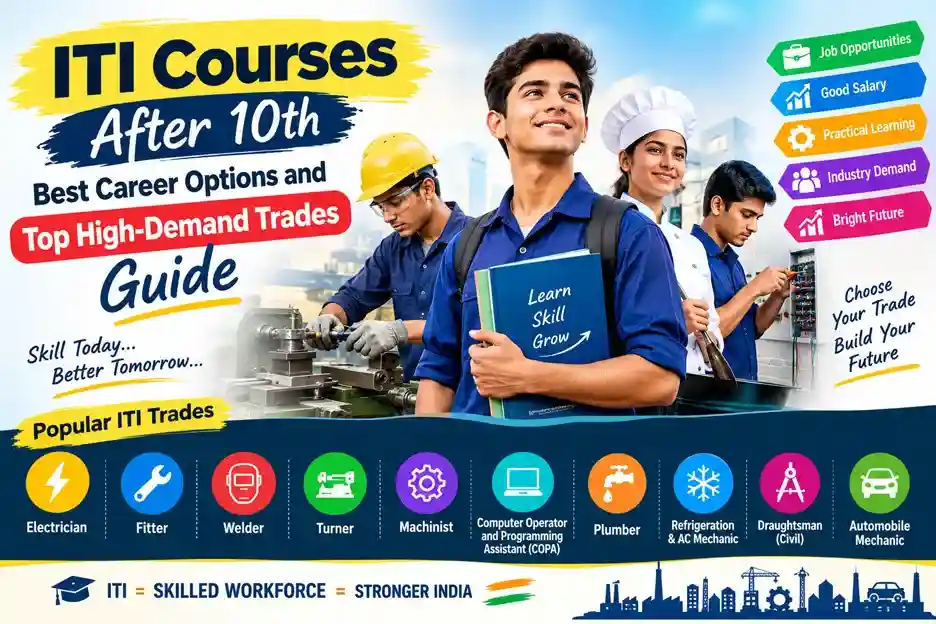
After completing the 10th-grade board exams, almost every student faces a massive dilemma: “Which stream should I choose next?” While the traditional path of pursuing Arts, Science, or Commerce in 11th and 12th grade is still popular, it is no longer the only route to a successful career. If your priority is to become financially independent quickly or if you have a knack for technical work, Industrial Training Institutes (ITI) courses are one of the most practical and lucrative options available today.
In this comprehensive guide, we will break down why pursuing an ITI course after the 10th is a game-changing move, which trades have the highest job market demand in 2026, and how to pick the right specialization to secure a steady government or private sector job.
What is an ITI Course?
An ITI (Industrial Training Institute) is a specialized vocational training program managed under the Directorate General of Training (DGT) and the Ministry of Skill Development and Entrepreneurship, Government of India. Unlike traditional academic degrees that focus heavily on textbook definitions, the core mission of an ITI is to provide hands-on, practical training.
Simply put, ITI centers function as industry prep-schools. They train students in exact technical skills—such as welding, wiring, and mechanical repair—making them instantly employable in large factories, Power plants, the Railways, and Corporate engineering sectors.
Key Benefits of Pursuing ITI Course After 10th Grade
Why should you step off the beaten track of conventional schooling to join an ITI? Here are the most compelling reasons:
- Fast Track to Self-Reliance: Traditional graduation paths can take 5 to 6 years of studying before you earn your first paycheck. In contrast, ITI courses last only 1 to 2 years, allowing you to enter the professional workforce at a very young age.
- Highly Affordable Education: Government-run ITI colleges, especially across states like West Bengal, offer these courses at nominal, highly subsidized fees. This makes it an incredibly viable option for middle-class and budget-conscious families.
- 80% Practical Learning: The curriculum is entirely workshop-centric. You spend most of your time working with actual machines and equipment rather than just memorizing theories, ensuring you become a confident technician by the time you graduate.
- Golden Ticket to Indian Railways: Major public sectors, most notably the Indian Railways, have now made an ITI certification mandatory for core technical vacancies like Assistant Loco Pilot (ALP) and Technicians.
Top 5 High-Demand ITI Trades in 2026
While there are dozens of vocational branches available, not all trades carry the same weight in the modern job market. Based on current industrial trends, here are the top 5 most stable and high-paying trades to target:
1. Electrician (Duration: 2 Years)
This is the undisputed, evergreen king of ITI trades. The demand for qualified electricians across commercial, residential, and industrial sectors never hits a slump.
- Career Scope: Massive recruitment drives regularly happen in the Indian Railways, State Electricity Boards (like WBSEDCL), Metro Rail corporations, and private giants like Tata Power.
- Future Growth: After gaining a few years of experience, you can easily apply for an independent electrical contractor license and establish your own electrical consultancy or servicing business.
2. Fitter (Duration: 2 Years)
Equal in status to the Electrician trade, Fitter is a mechanical branch. It involves learning how to assemble, structurally fit, and repair heavy machinery parts and manufacturing plant components.
- Career Scope: Fitters are heavily recruited by Indian Railway Workshops, Ordnance Factories, Steel Authority of India (SAIL), GAIL, and major automobile assembly plants (such as Tata Motors or Maruti Suzuki).
- Future Growth: Anywhere there is a manufacturing hub or heavy industry setup, Fitters remain the backbone of the operational workforce.
3. COPA – Computer Operator and Programming Assistant (Duration: 1 Year)
If you prefer working in an air-conditioned office environment over a heavy machinery workshop, COPA is your best fit. It is a highly popular 1-year non-engineering trade.
- What You Learn: Computer fundamentals, Internet routing, High-speed data entry, database management, and basic programming scripts like JavaScript.
- Career Scope: Immediate employment as Data Entry Operators, IT Lab Assistants, or administrative support technicians across private offices, cyber complexes, and educational institutions.
4. Welder (Duration: 1 Year)
For students who need an urgent income source within just twelve months, the Welder trade provides the fastest route into heavy manufacturing industries.
- Career Scope: Ship building yards, railway coach factories, structural bridge construction companies, and structural steel industries.
- Global Exposure: Certified welders are in exceptional demand overseas. Passing this course opens doors to high-paying technical job placements in Middle Eastern countries like Dubai, Qatar, and Oman.
5. Mechanic Motor Vehicle – MMV (Duration: 2 Years)
With millions of new two-wheelers, luxury cars, and commercial trucks hitting the roads every single year, the automotive servicing sector is booming. This trade teaches you the precise internal mechanics of modern combustion and electric vehicle engines.
- Career Scope: Authorized service centers of major brands (Maruti, Hyundai, Honda), state transport corporations, and railway maintenance divisions.
- Future Growth: The skills learned put you in a perfect position to eventually launch a modern, computerized automobile garage of your own.
How to Pick the Right Trade For Yourself
To make the right choice, align your decision with two main factors:
- Your Natural Interest: If you love fiddling with wires, home appliances, or mechanical objects, choose engineering trades like Electrician or Fitter. If you enjoy digital tasks, stick to COPA.
- Your Financial Timeline: If your family needs financial backing immediately, go for 1-year programs (Welder/COPA). If you can invest two years for a broader, long-term career cushion, pick Electrician or Fitter.
Conclusion
Opting for an ITI course right after your 10th standard gives you a massive head start over your peers in the job market. Furthermore, if you wish to pursue higher education later, an ITI certificate unlocks lateral entry directly into the 2nd year of a Polytechnic Diploma Engineering course.
Analyze your strengths, choose a trade with a clear market demand, and focus entirely on mastering the practical craft. Success will inevitably follow.

