

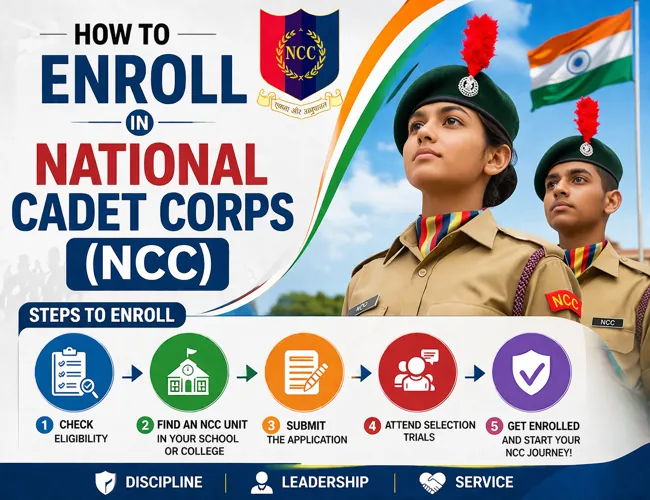
Eligibility, Benefits and Advantages of National Cadet Corps (NCC):
The National Cadet Corps is the young wing of Armed forces with its headquarters at New Delhi, Delhi, India. It is available to class VIII and understudies on intentional premise. National Cadet Corps is a Tri-Services organization, including the Army, Navy and Air Wing, occupied with prepping the young people of the nation into trained and devoted residents.
The National Cadet Corps in India is deliberate association which initiates cadets from secondary schools, Higher optional, Universities and colleges all over India. The Cadets are given fundamental military preparing in little arms and marches.
Qualification Condition:
- Citizen of India or Nepal.
- Bearing great good character.
- Enrolled in an instructive organization.
- Meets the recommended medicinal benchmarks.
- Age:
- Junior Division/wing (Boys/Girls)-12years to 18.6 years.
- Senior Division/Wing (Boys/Girls)- up to 26years.
6. Enrollment Period
- Junior Division/Wing (Boys/Girls)- 2 years
- Senior Division/Wing (Boys/Girls)- 3 years
Application for Enrollment
(a) An understudy envious of being taken a crack at the Senior Division will apply to the Officer Commanding of the closest NCC Unit; while an understudy burning of being selected the junior division ought to apply to the Headmaster/Principal of the school in the endorsed structure.
(b) There is arrangement for understudies burning of trying out NCC even from instructive organizations that are not enrolled as NCC sub-units. In this arrangement of open category, the understudy needs to move toward the commanding officer of the closet NCC Unit for additional direction. The understudies would thus be able to profit NCC preparing from foundation that are as of now NCC sub units, subject to following conditions:-
- The instructive foundation where in the understudy is contemplating ought not be having NCC.
- The instructive foundation wherein the understudy is envious of experiencing NCC preparing ought to be set under a NCC unit that has been pronounced an “open unit” by the Competent Authority.
This plan helps with expanding Senior Division/Senior Wing inclusion to those 10+2 schools which have just Junior Division working in those schools and Senior Division unit can’t be allocated because of some explanation or the other. Further,it loans a chance to those testament holders, who wish to get ‘B’ and ‘C’ authentication and don’t have NCC in their schools.
Enrollment process of National Cadet Corps:
- An understudy envious of being joined up with the Senior Division will apply to the officer instructing the unit.
- An understudy burning of being taken on the Junior Division will apply to the Headmaster of the schools giving the unit or part thereof.
- The officer to whom an application under sub-rule (1) has been made ,will make the candidate top off and sign in his quality an announcement in Form I.
- The Headmaster to whom an application under sub-rule (2) has been made will make the candidate top off and sign in his essence an announcement in Form II.
Confirmation:
At the point when an application is made to a commanding officer or a Headmaster under standers 7, he will fulfill himself that the application is in appropriate structure and that the candidate satisfies the states of enrollment determined in rule 5 or 6, by and large.
The Commanding Officer or the Headmaster may make such further inquiry in regards to the reasonableness of the candidate for enrollment in the unit or part thereof in which he wants to be selected, as might be recommended for this benefit, by the state Government.
Restorative Examination:
In the event that the Commanding Officer or the Headmaster is fulfilled that the application is all together, and that the candidate satisfies the States of enrollment and that he is appropriate for enrollment in the unit or part thereof in which he wants to be selected, he will make the candidate be medicinally analyzed.
On the off chance that the Commanding officer or the Headmaster is not fulfilled that the application is all together or that the candidates satisfies the states of enrollment or that he is responsible to be joined up with the unit or part thereof or the candidate is accounted for to be restrictively unit for administration in the National Cadet Corps, the Commanding officer or the Headmaster will dismiss the application and will advise the candidate in like manner.
Strategy for Enrollment:
- If the Commanding officer doesn’t dismiss the application, the candidate will be acknowledged for enrollment in the Senior Division/Wing, and will be required to sign a statement in Form I. On the off chance that the candidate is a minor, his dad or watchman will likewise be required to sign a statement gave in the structure.
- If the Headmaster doesn’t dismiss the application, the candidate will be acknowledged for enrollment in the Junior Division. The candidate will be required to sign a presentation in Form II and his dad or gatekeeper will likewise be required to sign a revelation in the Form.
If the commanding officer or the Headmaster is fulfilled that the candidate, or his dad or gatekeeper on account of a minor candidate, comprehend the inquiries put to the candidate and agree to the States of administration, he will sign an authentication with that impact on the said Form, and the candidate will immediately be considered to have been selected.
For more Information https://indiancc.mygov.in/
Frequently Asked Questions (FAQ) Regarding National Cadet Corps (NCC)
Q1: What is the full form of NCC?
Answer: The full form of NCC is the National Cadet Corps. It is the youth wing of the Indian Armed Forces (Army, Navy, and Air Force) that aims to develop discipline, character, brotherhood, and the spirit of selfless service among school and college students.
Q2: What is the eligibility criteria to join the NCC?
Answer: To join the NCC, an applicant must fulfill the following conditions:
- Nationality: Must be a citizen of India or a subject of Nepal.
- Age Limit: For the Junior Division (Schools), the age must be between 12 to 18.5 years. For the Senior Division (Colleges/Universities), the age must be under 26 years.
- Enrollment: Must be enrolled in a recognized school, college, or university.
- Fitness: Must meet the medical and physical fitness standards prescribed by the NCC battalion.
Q3: How can I join NCC if my school or college does not have an NCC unit?
Answer: If your educational institution does not offer NCC, you can still join as an Open Cadet. To do this, you need to visit the nearest NCC Battalion Office in your district. They will guide you to a nearby school or college that accepts open enrollment under their unit.
Q4: What are the different certificates awarded in NCC?
Answer: NCC training is structured into three certification levels based on duration and examinations:
- ‘A’ Certificate: Awarded to Junior Division cadets after completing 2 years of training in school.
- ‘B’ Certificate: Awarded to Senior Division cadets after completing 2 years of training in college and attending at least one camp.
- ‘C’ Certificate: The highest and most valuable certificate. Awarded to Senior Division cadets who hold a ‘B’ certificate, complete their 3rd year of training, and attend a minimum of two national/annual camps.
Q5: What are the career benefits of an NCC ‘C’ Certificate in the Indian Armed Forces?
Answer: An NCC ‘C’ Certificate provides exceptional advantages for defense aspirants:
- Special Entry Scheme: Cadets can directly appear for the SSB (Services Selection Board) Interview without clearing the written exams for the Indian Army, Navy, and Air Force (e.g., through NCC Special Entry for OTA).
- Bonus Marks: Cadets receive significant bonus marks in written examinations for Agniveer recruitments and other non-commissioned ranks.
Q6: Do NCC cadets get advantages in Government and Police Jobs?
Answer: Yes. Central Armed Police Forces (CAPF) like BSF, CRPF, CISF, and ITBP offer bonus marks to NCC certificate holders. Additionally State Police recruitments, including West Bengal Police (WBP) and Kolkata Police, grant special preferences and extra weightage marks to NCC cadets during selection.
Q7: Are there any benefits of NCC in private sector jobs?
Answer: Yes. Major corporate houses, multinational companies, and private security agencies give high preference to former NCC cadets. They value the leadership skills, strict discipline, punctuality, and team-management qualities that are deeply ingrained during NCC training.
Q8: Is there any fee or hidden cost to join the NCC?
Answer: No. Joining and training in the NCC is completely free of cost. The Ministry of Defence provides all uniforms, kits, camp accommodation, travel expenses, and daily allowances at no expense to the student.

Bristi Pramanik