

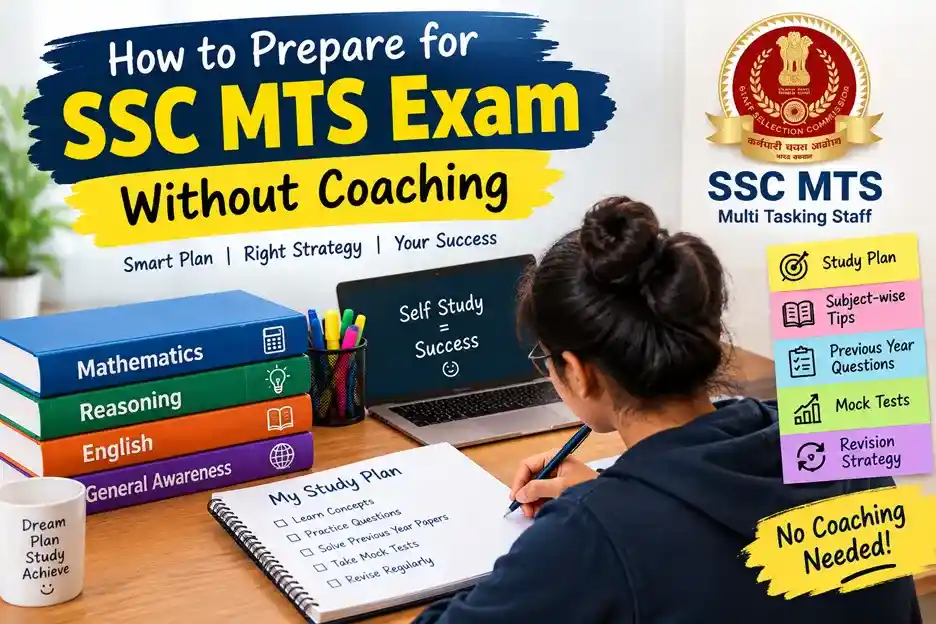
If you Preparing for a government job exam without joining a coaching centre may seem difficult at first. Many students think that coaching is necessary to understand the syllabus, solve questions and stay motivated. But the reality is different. With the right study material, a practical timetable and regular practice, you can prepare for the SSC MTS exam through self study.
The Staff Selection Commission (SSC) Multi Tasking Staff or MTS, exam is conducted for recruitment to various non technical Group C posts. Every year, a large number of candidates apply for these posts, so preparation needs to be planned from the beginning.
If you are preparing for SSC MTS without coaching, this guide will help you understand where to start, what to study and how to use your time effectively.
1. First Understand the SSC MTS Exam
Before opening a book or watching online classes, understand the exam structure and syllabus mentioned in the latest SSC MTS notification.
The computer-based examination generally covers areas such as:
- Numerical and Mathematical Ability
- Reasoning Ability and Problem Solving
- General Awareness
- English Language and Comprehension
The examination also requires candidates to manage their time carefully. Therefore, knowing the subjects and question pattern beforehand will help you create a focused preparation plan.
Do not start your preparation by collecting dozens of books. First understand what the examination actually asks.
2. Make a Realistic Study Plan
A good timetable is more useful than studying randomly for long hours. If you are studying without coaching, decide how much time you can realistically give every day. A student who can study for four focused hours daily can make better progress than someone who plans to study for ten hours but follows the timetable for only two or three days.
For example – your daily schedule could look like this:
Morning: Mathematics practice
Afternoon: English and vocabulary
Evening: Reasoning practice
Night: General Awareness and revision
You can change this schedule according to your school, college, job or other responsibilities. The important thing is consistency.
3. Start With the Basics
One common mistake made by SSC MTS aspirants is jumping directly into difficult questions.
If your mathematics or English basics are weak, spend some time strengthening them first. Learn the basic concepts and then move towards exam-level questions.
For Mathematics, revise topics such as percentages, averages, ratio and proportion, profit and loss, simple interest, time and work, time and distance, fractions and basic arithmetic.
For English, Work on grammar, Vocabulary, Sentence structure, Reading comprehension and common errors. Once your basics become stronger, solving previous-year questions becomes much easier.
4. How to Prepare for Numerical and Mathematical Ability
Mathematics requires regular practice. Watching a solution is not the same as solving a question yourself.
Start with basic arithmetic and gradually increase the difficulty.
- Number system
- Percentage
- Average
- Ratio and proportion
- Profit and loss
- Simple interest
- Time and work
- Time, speed and distance
- Data interpretation
- Mensuration
- Basic algebra
Keep a separate notebook for formulas and shortcuts. Whenever you make a mistake, write down the reason for that mistake.
After a few weeks, you will notice that some types of questions are repeated. Learning the method behind these questions can improve both speed and accuracy.
5. How to Prepare for Reasoning
Reasoning can become a scoring section if you practice regularly. Start with topics that you understand easily and gradually move towards more time-consuming problems. You can practise:
- Analogy
- Classification
- Number and alphabet series
- Coding-decoding
- Direction sense
- Blood relations
- Venn diagrams
- Non-verbal reasoning
- Missing numbers
- Basic puzzles
Try solving questions without immediately looking at the solution. If you cannot solve a question, understand the method after attempting it. Then solve a similar question on your own.
6. How to Prepare for English
English preparation should not be limited to memorizing vocabulary. Develop the habit of reading something in English every day. It could be a newspaper article, editorial, short story or a reliable online article. Along with reading practice:
- Grammar rules
- Vocabulary
- Synonyms and antonyms
- One-word substitutions
- Spelling
- Sentence correction
- Fill in the blanks
- Reading comprehension
Maintain a small vocabulary notebook. Write down unfamiliar words along with their meanings and revise them regularly. Even 20–30 minutes of English practice every day can make a difference over time.
7. How to Prepare for General Awareness
General Awareness can feel difficult because the syllabus is broad.
Instead of trying to memorise everything, divide your preparation into smaller areas. Focus on topics such as:
- Indian history
- Geography
- Indian polity
- Economy
- General science
- Important national events
- Sports
- Awards and honours
- Important government schemes
- Current affairs
For static subjects, use one reliable source and revise it repeatedly. For current affairs, follow a consistent monthly source rather than jumping between many different websites and videos.
8. Previous Year Questions Are Very Important
If you are preparing without coaching, previous-year question papers should be a regular part of your preparation.
- The type of questions asked
- Frequently tested topics
- Difficulty level
- Your weak areas
- How much time you need for different sections
Do not simply solve the paper and check your score. Analyse your mistakes.
For example, if you repeatedly get percentage questions wrong, return to that topic and practise it again. Your mistakes can tell you where your preparation needs more attention.
9. Take Mock Tests Regularly
Mock tests should become part of your preparation as the exam gets closer. Initially you can take a mock test every week. Later, increase the frequency according to your preparation level. After every mock test, check:
- Which questions were wrong?
- Which questions took too much time?
- Which topics need revision?
- Did you make calculation mistakes?
- Did you spend too much time on one section?
Your score is useful, but the analysis after the test is even more useful.
10. Use Free Online Resources Carefully
You do not need to spend a large amount of money on coaching. There are many free study resources available online, including video lessons, practice questions, current-affairs material and mock tests. avoid following different teachers for the same subject.
Choose one or two reliable sources and follow them consistently. Constantly changing study materials can waste time and create confusion.
11. Create a Mistake Notebook
This is one of the simplest techniques for self-study. Keep a notebook specifically for mistakes. Whenever you see any important mistake while solving previous year questions or taking mock tests, be sure to note it down.
- The question type
- Your mistake
- The correct method
- Any formula or rule involved
Revise this notebook once or twice every week. Over time, it becomes a personalised revision book based on your actual weaknesses.
12. Follow a Weekly Revision System
Studying new topics every day without revision can make you forget what you learned earlier. Keep at least one session every week for revision.
For example:
Monday to Friday: New topics + practice
Saturday: Previous-year questions
Sunday: Revision + mock test + mistake analysis
You can change the schedule according to your needs. The goal is to create a cycle of learning, practising, testing and revising.
13. Don’t Ignore Speed and Accuracy
SSC exams require candidates to solve questions within a limited amount of time. During the first stage of preparation, focus more on understanding concepts and maintaining accuracy.
Once you become comfortable with the topics, start working on speed. Use a timer while solving practice sets. Try to reduce the time gradually without allowing your accuracy to fall sharply. Fast solving is useful only when your answers are reliable.
14. What If You Have Only 3 Months?
Three months can still be used effectively if you have a clear plan.
First Month: Focus on completing the basic concepts of all major subjects. Start solving easy and moderate questions.
Second Month: Increase your practice. Solve previous-year questions and begin taking regular mock tests.
Third Month: Focus heavily on revision, mock tests, previous-year papers and weak topics.
Avoid starting completely new books during the final weeks unless there is a specific reason to do so.
15. Common Mistakes to Avoid
Many candidates lose valuable preparation time because of poor study habits. Avoid these mistakes:
- Collecting too many books.
- Changing study sources repeatedly.
- Watching classes without practising questions.
- Ignoring previous-year papers.
- Avoiding mock tests because of low scores.
- Studying only favourite subjects.
- Leaving revision until the final week.
- Spending too much time on one difficult topic.
- Comparing your preparation with other candidates.
Your preparation should be based on your own progress.
16. How Many Hours Should You Study?
There is no fixed number of hours that guarantees success. For someone studying full-time, 5–7 focused hours can be useful if the time is divided properly. Students who have college, school or a job may have less time.
Even 3–4 productive hours can be valuable when followed consistently.
Instead of asking, “How many hours did I study today?”, also ask, “What did I actually complete today?” That question gives you a much clearer picture of your preparation.
17. A Simple Daily Routine for SSC MTS Preparation
Here is an example of a self-study routine:
2 hours: Mathematics
1 hour: Reasoning
1 hour: English
1 hour: General Awareness
30 minutes: Revision
30 minutes: Previous-year questions or a practice set
If you have less time, reduce the duration but try to cover the subjects regularly.
Preparing for the SSC MTS exam without coaching is possible when you have a clear plan and follow it consistently.
You do not need an expensive coaching programme to begin your preparation. Start with the official syllabus, choose reliable study material, build your basics, practise previous-year questions and take mock tests regularly.
Most importantly, do not judge your preparation by one bad mock test or one difficult day. Track your mistakes, revise regularly and keep improving one topic at a time.
Self-study requires discipline because nobody is there to remind you to study. But if you can maintain that discipline, you can build your SSC MTS preparation around your own schedule and learning style.
Start with a realistic target, study every day and keep your preparation focused.

