

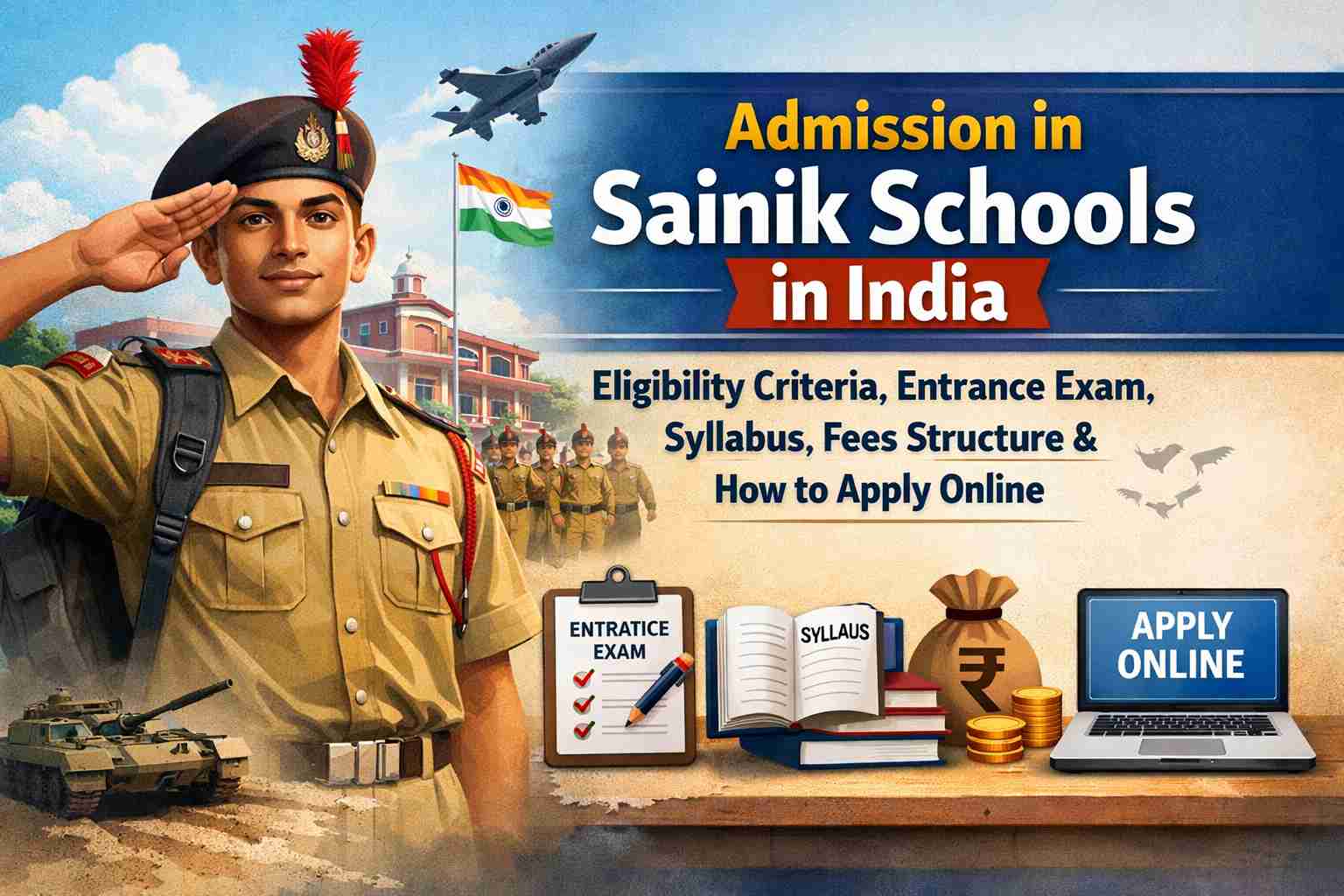
Complete Guide to Admission in Sainik Schools in India: Eligibility Criteria, Entrance Exam, Syllabus, Fees structure & How to Apply Online
Sainik Schools in India are widely recognized for their discipline, academic excellence, and strong foundation for students aspiring to join the armed forces. Established under the Sainik Schools Society, these institutions aim to prepare young students Mentally, Physically and Academically for a career in Defence services, particularly entry into the National Defence Academy.
With increasing competition and limited seats, gaining admission into a Sainik School requires a clear understanding of the process, eligibility, and preparation strategy. This detailed guide will walk you through every aspect of the admission process in a simple and practical way.
What Are Sainik Schools?
Sainik Schools are residential, English medium institutions affiliated with the Central Board of Secondary Education (CBSE). They were established to remove regional imbalance in officer intake in the Indian Armed Forces and to provide quality education combined with military training.
Currently, there are more than 30 Sainik Schools across India, located in different states, offering a structured and disciplined environment that fosters Leadership, Confidence and Patriotism among students.
List of State wise Sainik Schools:
| State | Sainik School |
| Andhra Pradesh | Sainik School Korukonda (Dist Vizianagaram) Sainik School Kalikiri (Dist Chittoor) |
| Arunachal Pradesh | Sainik School East Siang (Dist East Siang) |
| Assam | Sainik School Goalpara (Dist Goalpara) Sainik School Assam (Assam) |
| Bihar | Sainik School Nalanda (Nalanda) Sainik School Gopalganj (Gopalganj) |
| Chattishgarh | Sainik School Ambikapur (Dist Sarguja) |
| Gujrat | Sainik School Balachadi (Dist Jamnagar) |
| Haryana | Sainik School Kunjpura (Dist Karnal) Sainik School Rewari (Dist Rewari) |
| Himachal Pradesh | Sainik School Sujanpur Tira (Dist Hamirpur) |
| Jammu & Kashmir | Sainik School Nagrota (Dist Jammu) Sainik School Manasbal (Dist Srinagar) |
| Jharkhand | Sainik School Tilaiya (Dist Koderma) |
| Karnataka | Sainik School Bijapur (Dist Bijapur) Sainik School Kodagu (Dist Kodagu) |
| Kerala | Sainik School Kazhakootam (Dist Thiruvananthapuram) |
| Madhya Pradesh | Sainik School Rewa (Rewa) |
| Manipur | Sainik School Imphal (Dist Imphal) |
| Maharashtra | Sainik School Satara (Dist Satara) Sainik School Chandrapur (Dist Chandrapur) |
| Mizoram | Sainik School Chhingchhip (Dist Chhingchip) |
| Monipur | Sainik School Imphal (Dist Imphal) |
| Odisha | Sainik School Bhubaneswar (Dist Bhubaneswar) Sainik School Sambalpur (Dist Sambalpur) |
| Nagaland | Sainik School Punglwa (Dist Punglwa) |
| Punjab | Sainik School Kapurthala (Dist Kapurthala) |
| Rajasthan | Sainik School Chittorgarh (Dist Chittorgarh) Sainik School Jhunjhunu (Dist Jhunjhunu) |
| Tamilnadu | Sainik School Amaravathinagar (Dist Udmalpet) |
| Uttarakhand | Sainik School Ghorakhal (Dist Ghorakhal) |
| Uttar Pradesh | Sainik School Lucknow (Dist Lucknow) Sainik School Ghorakhal (Dist Nainital) Sainik School Jhansi (Dist Jhansi) Sainik School Mainpuri (Dist Mainpuri) Sainik School Mathura (Dist Mathura) |
| West Bengal | Sainik School Purulia (Dist Purulia) |
Classes Offered for Admission
Admissions are primarily open for:
- Class 6 (Entry Level)
- Class 9 (Limited Seats)
Maximum students apply for Class 6, as it has a larger number of seats and allows longer exposure to the Sainik School environment.
Eligibility Criteria
Understanding eligibility is the first step toward applying successfully.
For Class 6:
- Age should be between 10 to 12 years as of 31 March of the admission year.
- Both boys and girls are eligible (as per current policy).
For Class 9:
- Age should be between 13 to 15 years.
- The candidate must have passed Class 8 from a recognized school.
It is important to strictly follow the age criteria, as applications not meeting these requirements are rejected.
Entrance Exam: AISSEE ( All India Sainik Schools Entrance Examination)
Admission to Sainik Schools is conducted through the All India Sainik Schools Entrance Examination, which is organized by the National Testing Agency.
This is a national-level entrance exam and the most critical stage in the admission process.
AISSEE Exam Pattern
For Class 6:
Subjects are:
- Mathematics
- General Knowledge
- Language (English/Hindi)
- Intelligence
For Class 9:
Subjects are:
- Mathematics
- English
- General Science
- Social Studies
- Intelligence
Exam Mode:
- Offline (pen and paper)
- Objective type (Multiple Choice Questions)
The difficulty level is moderate, but competition is high due to the large number of applicants.
Step by Step Admission Process
Getting into a Sainik School involves multiple stages:
1. Online Application
Candidates must apply online through the official portal of the National Testing Agency.
Steps involved:
- Register with basic details.
- Fill out the application form.
- Upload required documents (Photograph and Signature).
- Pay the application fee
The application window usually opens between October and November each year.
2. Download Admit Card
Once the application is accepted, candidates can download their admit cards before the exam. It contains important details like Exam center, Date and Timing.
3. Appear for AISSEE
The entrance exam is generally conducted in January.
Students should:
- Reach the exam center on time.
- Carry admit card and ID proof.
- Follow exam instructions carefully.
4. Result Declaration
Results are usually announced in February or March. Candidates are shortlisted based on their performance and category-wise merit lists.
5. Medical Examination
Candidates who clear the written exam must undergo a medical test conducted at authorized military hospitals.
Medical tests include:
- Eye and vision check
- Hearing ability
- Physical fitness
- General health condition
Medical fitness test pass is mandatory for final selection.
6. Final Merit List
The final selection depends on:
- AISSEE score
- Medical fitness
- Reservation category
- Seat availability
Reservation System
Sainik Schools follow a structured reservation policy:
- 67% seats reserved for candidates from the home state.
- 33% seats for candidates from other states.
Additional reservations:
- SC/ST Categories
- OBC NCL(Non-creamy layer)
- Children of defense personnel
This system ensures fair representation from different regions and backgrounds.
Documents Required
Candidates must keep the following documents ready:
- Birth certificate
- Aadhaar card
- Previous class mark sheet
- Domicile certificate (SDO)
- Caste/category certificate (If applicable)
- Passport size photographs
Ensure all documents are valid and correctly uploaded during the application process.
Fee Structure and Scholarships
The fee structure varies from school to school but generally includes:
- Tuition fees
- Hostel charges
- Mess charges
- Uniform and study materials
Although Sainik Schools are more affordable than private boarding schools, the cost may still be significant for some families.
Scholarships:
Various scholarships are available for:
- Economically weaker sections
- SC/ST students
- Children of defence personnel
State Governments also offer financial assistance in many cases.
Preparation Strategy for AISSEE
Success in AISSEE depends on smart preparation and consistency. Here are some effective tips:
1. Know the Syllabus: Understand the exam pattern and topics thoroughly before starting preparation.
2. Strengthen Basics: Focus on fundamental concepts, especially in Mathematics and English.
3. Practice Regularly: Solve previous years question papers to get familiar with the exam format.
4. Take Mock Tests: Mock exams help improve speed, accuracy, and confidence.
5. Manage Time Efficiently: Practice solving questions within a time limit to enhance exam performance.
Life Inside a Sainik School: Life in a Sainik School is structured and disciplined. Students follow a daily routine that balances academics, physical training, and extracurricular activities.
Learning in Sainik Schools:
- Early morning physical training (From 04.00a.m).
- Regular academic classes.
- Sports and Outdoor activities.
- NCC (National Cadet Corps) training.
- Personality and leadership development programs.
Students are trained to become Confident, Responsible and Physically fit individuals.
Benefits of Studying in a Sainik School
Choosing a Sainik School offers several long-term advantages:
- Strong academic foundation.
- Preparation for defense services.
- Development of Discipline and Leadership.
- Affordable residential education.
- Exposure to competitive exams like NDA.
Students graduating from these schools often excel in various fields, not just the military.
Common Mistakes to Avoid
- Not understanding the exam pattern.
- Ignoring time management during preparation.
- Lack of practice with mock tests.
- Submitting incorrect application details.
- Neglecting medical fitness requirements.
**Avoiding these mistakes can significantly improve your chances of success.
Admission to Sainik Schools in India is a competitive yet rewarding journey. These institutions not only provide quality education but also shape students into disciplined and responsible individuals ready to serve the nation.
With proper Planning, Consistent effort and a focused approach toward the All India Sainik Schools Entrance Examination, students can successfully secure a seat in one of these prestigious schools. If your goal is to build a strong career foundation, especially in defense services, Sainik Schools offer one of the best pathways in India.

