

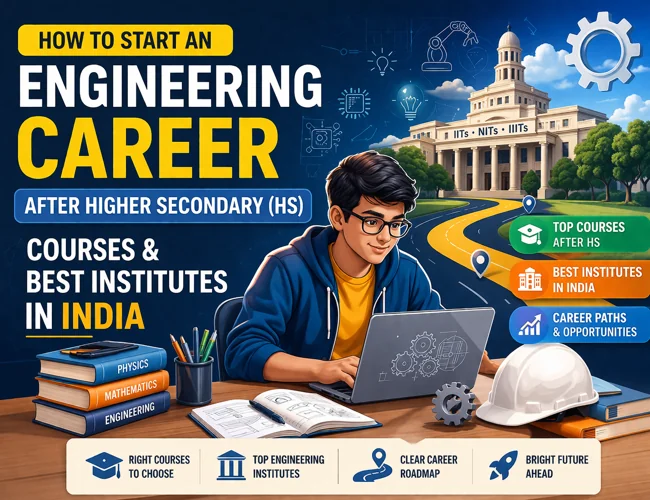
How to Start an Engineering Career After Higher Secondary (HS): Courses & Best Institutes in India
Starting Engineering Career after Higher Secondary (HS) can feel both exciting and overwhelming, especially when you are thinking about a career in engineering. With so many courses, entrance exams, and colleges available, it is completely normal to feel confused about where to begin. However, the truth is simple – Every successful engineer once stood exactly where you are today, unsure but full of potential.
Engineering is not just about Machines, Codes or Formulas; rather, it is about solving real-world problems and turning ideas into reality. From building modern cities to developing smart technologies, engineers play a key role in shaping the future. Therefore, if you take the right steps at the right time, you can build a strong and rewarding career path immediately after 12th.
Why Choose Engineering Career After HS?
Engineering is not just a degree, It is a gateway to Innovation, Technology and Problem solving. Moreover, it offers:
- High career stability.
- Multiple specialization options.
- Opportunities in both Government and Private sectors.
- Global career scope.
In addition, engineers are always in demand in industries like IT, Construction, Manufacturing and Research.
Step by Step Guide to Start Engineering Career After HS.
1. Choose the Right Stream in HS
First of all, you must complete your 10+2 with pure science:
- Physics
- Chemistry
- Mathematics (PCM)
**Without PCM (Physics, Chemistry & Mathamatics Maximum Engineering courses are not accessible.
2. Select the Right Entrance Exam
To get into top engineering colleges, you need to clear entrance exams. The most popular ones include:
- JEE Main
- JEE Advanced
- BITSAT
- State level exams like WBJEE, MHT CET, etc.
As a result your rank in these exams determines your college options.
3. Choose the Right Engineering Course
After clearing exams, the next step is choosing a specialization. Some of the most popular branches are:
🔹 Core Engineering Branches
- Mechanical Engineering
- Civil Engineering
- Electrical Engineering
🔹 Modern & High Demand Branches
- Computer Science Engineering (CSE).
- Artificial Intelligence & Data Science.
- Electronics & Communication Engineering.
🔹 Emerging Fields
- Robotics Engineering
- Aerospace Engineering
- Environmental Engineering
Therefore, choose your branch based on your interest and future goals, not just trends.
Top Engineering Courses After HS
1. B.Tech (Bachelor of Technology)
- Duration: 4 years
- Most preferred engineering degree.
- Available in all major branches.
2. B.E. (Bachelor of Engineering)
- Similar to B.Tech but more theoretical in some universities.
3. Diploma in Engineering (Polytechnic)
- Duration: 3 years
- Direct entry after HS or even after 10th.
- Later, you can do lateral entry into B.Tech.
Best Engineering Institutes in India
Choosing the right institute is equally important. Here are some of the top institutions:
**Indian Institutes of Technology (IITs)
- Indian Institutes of Technology
- Admission through JEE Advanced.
- Known for world-class education and placements.
**National Institutes of Technology (NITs)
- National Institutes of Technology
- Admission through JEE Main
- Excellent infrastructure and faculty
**Top Private Engineering Institutes
- Birla Institute of Technology and Science (BITS Pilani)
- Vellore Institute of Technology (VIT)
- SRM Institute of Science and Technology (SRM)
These institutes offer quality education along with strong placement support.
Skills Required to Become a Successful Engineer
Even though a degree is important, skills matter the most. Therefore, focus on:
- Problem-solving ability
- Programming skills (for IT fields)
- Analytical thinking
- Communication skills
- Practical knowledge
In addition, internships and projects will boost your career growth.
Career Opportunities After Engineering
After completing your engineering degree, you can explore:
- Private sector jobs (IT companies, core industries)
- Government jobs (PSUs, SSC, Railways)
- Higher studies (M.Tech, MBA, MS abroad)
- Startups and Entrepreneurship
Thus, Engineering opens multiple career pathways.
Starting an Engineering career after Higher Secondary (10+2) is not just about choosing a course, it is about making informed decisions at the right time. At first, students need to focus on selecting the correct stream and preparing for entrance exams. Then, they should carefully choose a specialization that matches their interest and future goals. Moreover, getting admission into a reputed institute can significantly enhance learning opportunities and career growth.
However, Academic knowledge alone is not enough. Along with it, Developing practical skills, Gaining hands-on experience, and staying updated with industry trends are equally important. In addition, consistent effort and the willingness to learn can make a huge difference in this competitive field.
Ultimately, if you stay focused, plan wisely, and keep improving step by step, you can build a successful and future-ready Engineering career. Therefore, begin your journey with confidence today, because the decisions you make now will shape your tomorrow.

