

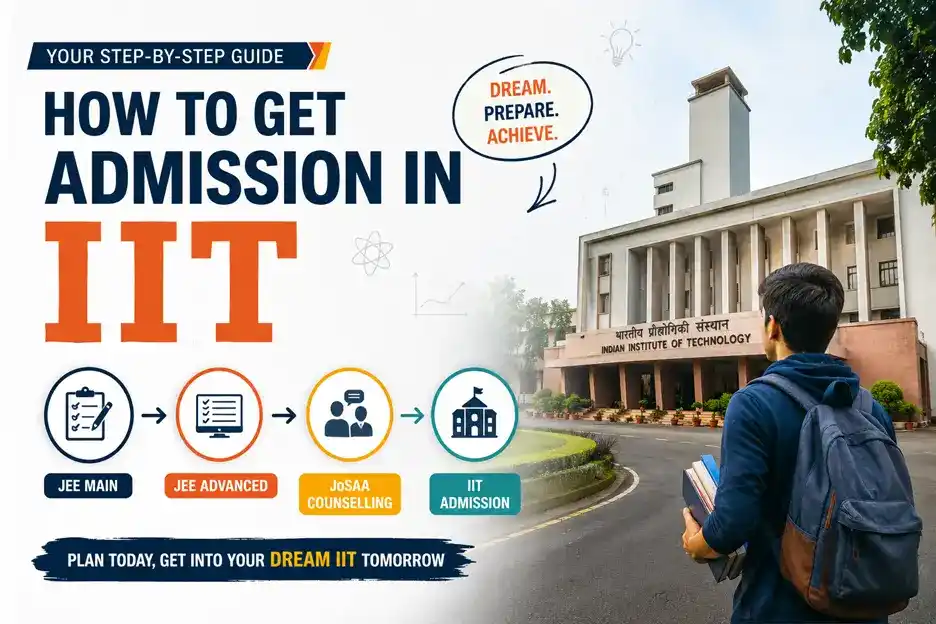
Getting admission to an Indian Institute of Technology, commonly known as an IIT, is a goal for many students after Class 12. Every year, lakhs of students prepare for the JEE examinations, but the route to an IIT is actually a step-by-step process. Understanding these steps early can make preparation much easier.
For undergraduate engineering admission, the main route is through JEE Main, JEE Advanced and JoSAA counselling.
What is an IIT?
The Indian Institutes of Technology are a group of centrally funded higher-education institutes in India. They offer undergraduate, postgraduate and doctoral programmes in engineering, technology, science, design and other fields.
For the 2026–27 admission cycle, JoSAA is conducting the common seat allocation process for 23 IITs along with other participating institutes.
How can a student get admission to IIT after Class 12?
For most students seeking admission to an IIT’s undergraduate programmes, the process looks like this:
Class 12 → JEE Main → JEE Advanced → JoSAA Counselling → Seat Allotment → IIT Admission
1. Complete Class 12 with the required subjects
Students interested in B.Tech and other engineering programmes generally need to study the subjects required by the particular programme, such as Physics, Chemistry and Mathematics.
However, eligibility can vary between programmes. Therefore, students should always check the latest JEE Advanced information brochure and the programme-specific requirements before applying.
The JEE Advanced rules also include Class 12 performance requirements for admission to IITs.
2. Appear for JEE Main
The first major examination is JEE Main, conducted by the National Testing Agency.
Students who want to compete for IIT admission generally need to qualify through the JEE Main route and meet the requirements specified for JEE Advanced.
It is important to remember that qualifying in JEE Main does not directly give admission to an IIT.
JEE Main is an important stage before appearing for JEE Advanced.
3. Appear for JEE Advanced
After JEE Main, eligible candidates can appear for JEE Advanced.
JEE Advanced is the examination used for admission to undergraduate programmes in IITs. Candidates must satisfy the eligibility conditions specified for the particular year.
For example, the JEE Advanced 2026 information brochure states that candidates who meet the specified eligibility requirements and the Class 12 performance criterion can be considered for admission to IITs.
The examination is highly competitive, so preparation should focus on understanding concepts rather than simply memorising formulas.
Physics, Chemistry and Mathematics all require regular practice.
4. Check your JEE Advanced rank
After JEE Advanced, candidates receive their results and rank, subject to the applicable rules.
Your rank becomes an important factor during the IIT seat allocation process.
However, rank alone does not determine which programme you will receive. The final allotment depends on factors such as:
- Your JEE Advanced rank
- Your category, where applicable
- Choices filled during counselling
- Availability of seats
- Programme-specific eligibility
- Seat-allocation rules
The Government of India reservation policies applicable to IIT admissions are followed during seat allocation.
5. Register for JoSAA counselling
After the entrance examination, eligible candidates need to participate in JoSAA counselling.
JoSAA stands for Joint Seat Allocation Authority.
For the 2026 admission cycle, JoSAA manages seat allocation for 23 IITs as well as NITs, IIEST, IIITs and other participating government-funded technical institutes.
This is the stage where students submit their preferences.
For example, a student may choose different combinations of:
- IIT Delhi – Computer Science
- IIT Bombay – Electrical Engineering
- IIT Kharagpur – Mechanical Engineering
- IIT Kanpur – Mathematics and Computing
The actual list of programmes and their availability changes from year to year, so students should check the official JoSAA information before filling in their choices.
6. Fill your choices carefully
Choice filling is an important part of the process.
Students should research the courses they are interested in before submitting their preferences. Do not select a course simply because its name sounds attractive.
Look at:
- Course curriculum
- Eligibility requirements
- Previous-year closing ranks
- Seat availability
- Institute
- Career interests
- Personal preference
JoSAA also publishes institute and programme-level eligibility restrictions, so candidates should check these before finalising their choices.
7. Seat allotment
JoSAA conducts multiple rounds of seat allocation.
If a seat is allotted, the candidate must follow the instructions shown on the official JoSAA portal. Depending on the situation, the candidate may need to choose an option such as Freeze, Float or Slide, where applicable under the current year’s rules.
The candidate must also complete the required fee payment and document-verification steps within the specified deadline.
Missing a deadline can result in the loss of the allotted seat, so candidates should check the official schedule regularly.
8. Complete admission at the IIT
Once the seat-allocation process is completed, the student has to follow the admission instructions of the allotted IIT.
- Document verification
- Payment of applicable admission fees
- Medical or other required formalities
- Physical or online reporting, as instructed
- Registration for the academic programme
The exact requirements can differ between institutes and programmes.
What documents are usually required?
Students should keep their important documents ready well before counselling.
Depending on the candidate and programme, documents may include:
- Class 10 certificate or equivalent
- Class 12 certificate/marksheet
- JEE Advanced documents
- Valid photo ID
- Passport-size photographs
- Category certificate, if applicable
- PwD certificate, if applicable
- Other documents specified by JoSAA or the allotted IIT
Candidates should follow the current year’s official document requirements rather than relying on an old checklist.
Is JEE Advanced enough for admission?
No, Clearing JEE Advanced does not mean that a particular IIT or course is automatically guaranteed.
Admission depends on the seat-allocation process, the candidate’s rank, choices, seat availability and applicable eligibility and reservation rules.
That is why students should treat JEE Advanced preparation and JoSAA choice filling as two different parts of the admission journey.
Can you get admission to an IIT without JEE Advanced?
For the standard undergraduate engineering admission route, JEE Advanced is the key examination.
However, IITs offer many different programmes and some programmes may have separate admission channels or examination requirements.
For example, IIT Kanpur announced an Olympiad-based admission channel for a specific undergraduate programme for the 2026–27 academic year. Such routes are programme-specific and should not be confused with the regular JEE Advanced route.
Therefore, students should always check the admission rules for the exact programme they want.
What about M.Tech, M.Sc. and PhD admission?
IIT admission is not limited to undergraduate courses.
For postgraduate and doctoral programmes, different examinations and selection processes may apply.
For example, GATE scores can be used for admission to various Master’s and direct doctoral programmes in engineering, technology, architecture, science, humanities and related fields, subject to the institute’s own eligibility and selection rules.
Other IIT programmes can have their own entrance examinations or admission procedures.
So, the correct entrance examination depends on the level and programme.
How should students prepare for IIT admission?
There is no single preparation method that works for every student. However, a few habits can make preparation more manageable.
Build strong fundamentals:
Understand the concepts in Physics, Chemistry and Mathematics before moving to difficult problems.
Solve previous-year questions:
They help students understand the type and difficulty of questions they may face.
Practise regularly:
Solving questions every day is more useful than studying for long hours only occasionally.
Analyse mistakes:
A wrong answer can be more useful than a correct answer if you understand why you made the mistake.
Take mock tests:
Mock tests help with time management and exam practice.
Keep checking official notices:
Exam dates, eligibility conditions, counselling procedures and other rules can change. Always check the official examination and counselling websites for the latest information.
A simple IIT admission roadmapStep 1: Complete Class 11 and 12 preparation
↓
Step 2: Appear for JEE Main
↓
Step 3: Meet the requirements for JEE Advanced
↓
Step 4: Appear for JEE Advanced
↓
Step 5: Check result and rank
↓
Step 6: Register for JoSAA
↓
Step 7: Fill and lock programme preferences
↓
Step 8: Participate in seat-allocation rounds
↓
Step 9: Accept the allotted seat and complete required formalities
↓
Step 10: Report to the allotted IIT and begin the programme
Getting into an IIT is a long process, and the journey does not begin with the counselling form. It starts much earlier with understanding the syllabus, building strong fundamentals and preparing consistently for the entrance examinations.
Students should also remember that an IIT admission is not simply about getting any seat. Before filling JoSAA choices, it is worth spending time understanding the courses and deciding what kind of subject and career path they actually want to pursue.
Most importantly, don’t depend on unofficial social-media posts for admission rules. Examination authorities and JoSAA publish the official eligibility conditions, schedules and admission procedures. For the current cycle, students should use the official JEE Advanced and JoSAA websites as their primary sources.
IIT Admission FAQs
1. What exam is required for IIT admission?
For the regular undergraduate admission route, students need to qualify through the JEE Main and JEE Advanced process and then participate in JoSAA seat allocation, subject to the applicable rules.
2. Is JEE Main enough to get into IIT?
No. JEE Main by itself does not provide admission to an IIT. Eligible candidates need to appear for JEE Advanced and participate in the subsequent admission process.
3. Can Class 12 students apply for JEE Advanced?
Students who satisfy the eligibility requirements specified for the relevant examination year can apply. The exact conditions should be checked in the official JEE Advanced information brochure.
4. Is there an interview for B.Tech admission to IIT?
For the regular JEE Advanced-based undergraduate admission route, admission is based on the examination and seat-allocation process rather than a conventional personal interview.
Specific programmes with separate admission routes may have different procedures.
5. How many IITs are there in India?
India has 23 IITs.
6. Is JoSAA counselling compulsory for IIT admission?
For the standard centralised IIT undergraduate seat-allocation route, eligible candidates need to participate in the JoSAA process to be considered for seat allocation.
7. Can I choose my IIT and branch?
Yes. During JoSAA choice filling, eligible candidates submit their preferred institutes and academic programmes. The final allotment depends on the applicable seat-allocation rules, rank, preferences, eligibility and seat availability.
8. What happens if I don’t get my first choice?
You may receive another programme or institute from your submitted preference list depending on your rank, eligibility and available seats. Further rounds may also be conducted according to the JoSAA schedule.
9. Can I get IIT admission after a diploma?
The answer depends on the specific programme and admission rules. Students should not assume that a diploma automatically provides entry into the regular first-year IIT B.Tech admission route.
10. Is IIT admission possible after graduation?
Yes. IITs offer postgraduate and doctoral programmes. Depending on the programme, admission can involve examinations such as GATE or other institute/ programme-specific selection processes.

