

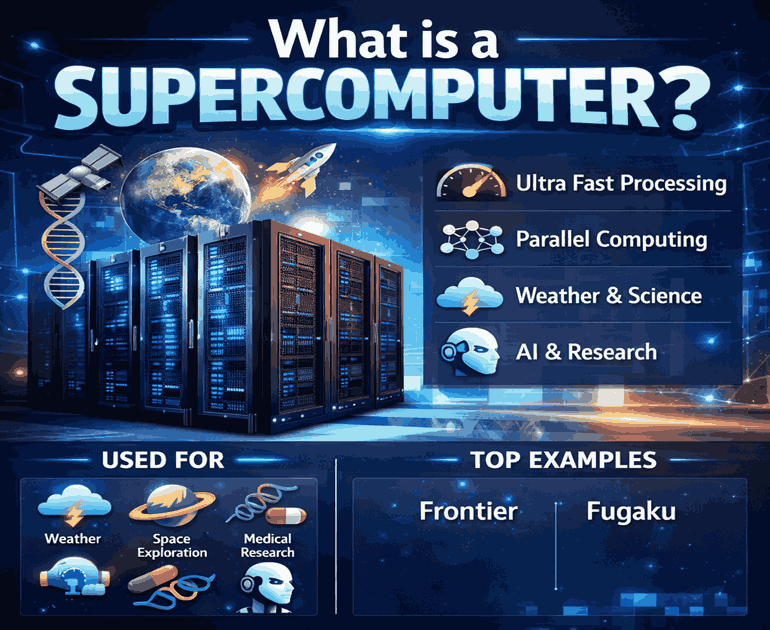
Definition of Supercomputer
Supercomputer, any of a category of extremely powerful computers. The term is usually applied to the fastest High-performance systems available at any given time. Such computer’s are used primarily for scientific and engineering work requiring exceedingly high-speed computations.
Common applications for Supercomputers include testing mathematical models for complex physical phenomena or designs, like climate and Weather, Evolution of the cosmos, Nuclear weapons and reactors, new chemical compounds (Especially for Pharmaceutical purposes) and Cryptology. As the cost of supercomputing declined within the 1990s, more businesses began to use supercomputers for marketing research and other business-related models.
A Supercomputer is an extremely powerful computer that can process vast amounts of data at incredibly high speeds. Unlike regular computers, which perform tasks one at a time, Supercomputers can handle millions or even billions of calculations simultaneously.
They are mainly used for tasks that require Heavy computation, such as Weather forecasting, Scientific simulations and Artificial intelligence.
Key Features of Supercomputers
1. High Speed
Supercomputers operate at speeds measured in FLOPS (Floating Point Operations Per Second). The fastest ones can perform Quadrillions of calculations per second.
2. Massive Processing Power
They use thousands or even millions of processors working together to complete tasks efficiently.
3. Parallel Processing
Instead of solving one problem step-by-step, Supercomputers divide tasks into smaller parts and solve them at the same time.
4. Large Storage Capacity
Supercomputers can store and process huge volumes of data, which is essential for research and analysis.
How Does a Supercomputer Work?
A Supercomputer works using a concept called Parallel Computing. It connects many processors in a network, allowing them to work together on different parts of the same problem. For example, in weather prediction, One processor may analyze Temperature, another Humidity, and another wind speed—all at the same time. This speeds up the overall process significantly.
Uses of Supercomputers
1. Weather Forecasting
Supercomputers help predict Weather patterns, Storms and Natural disasters.
2. Scientific Research
They are used in fields like Physics, Chemistry and Biology to run complex simulations.
3. Space Exploration
Organizations use Supercomputers to study Planets, Galaxies and Space missions.
4. Medical Research
Supercomputers help in Drug discovery, Disease analysis and Medical imaging.
5. Artificial Intelligence (AI)
They are used to train large AI models and process massive datasets.
Examples of Supercomputers
- Frontier (USA) – One of the fastest Supercomputers in the world.
- Fugaku (Japan) – Known for its Efficiency and Performance.
- Summit (USA) – Used for Scientific and Energy research.
India also has powerful Supercomputers like PARAM Siddhi-AI.
Advantages of Supercomputers
- Extremely fast processing.
- Ability to solve complex problems.
- Supports advanced research and innovation.
- Improves accuracy in predictions.
Disadvantages of Supercomputers
- Very expensive to build and maintain.
- Requires high power consumption.
- Needs advanced cooling systems.
- Limited access (only used by large organizations).
Future of Supercomputers
The future of supercomputers looks promising. With advancements in Quantum Computing and AI, supercomputers will become even more powerful and efficient. They will play a key role in solving global challenges such as climate change, disease control, and energy management.
Distinguishing Features of Supercomputer
Supercomputers have certain distinguishing features. Unlike conventional computers, they typically have quite one CPU (central processing unit), which contains circuits for interpreting program instructions and executing arithmetic and logic operations in proper sequence. The use of several CPUs to realize high computational rates is necessitated by the physical limits of circuit technology.
Electronic signals cannot travel faster than the speed of sunshine, which thus constitutes a fundamental regulation for signal transmission and circuit switching. This limit has almost been reached, due to miniaturization of circuit components, dramatic reduction within the length of wires connecting circuit boards, and innovation in cooling techniques (e.g., various supercomputer systems, processor and memory circuits are immersed during a cryogenic fluid to realize the low temperatures at which they operate fastest). Rapid retrieval of stored data and directions is required to support the extremely high computational speed of CPUs. Therefore, most supercomputers have a really large storage capacity, also as a really fast input/output capability.
Still another peculiarity of supercomputers is their use of vector arithmetic – i.e., they’re ready to operate pairs of lists of numbers instead of on mere pairs of numbers. For example, a typical supercomputer can multiply an inventory of hourly wage rates for a gaggle of factory workers by an inventory of hours worked by members of that group to supply an inventory of dollars earned by each worker in roughly an equivalent time that it takes a daily computer to calculate the quantity earned by one worker.

