

PMEGP Loan Eligibility & Advantages – A Complete Guide for New Entrepreneurs
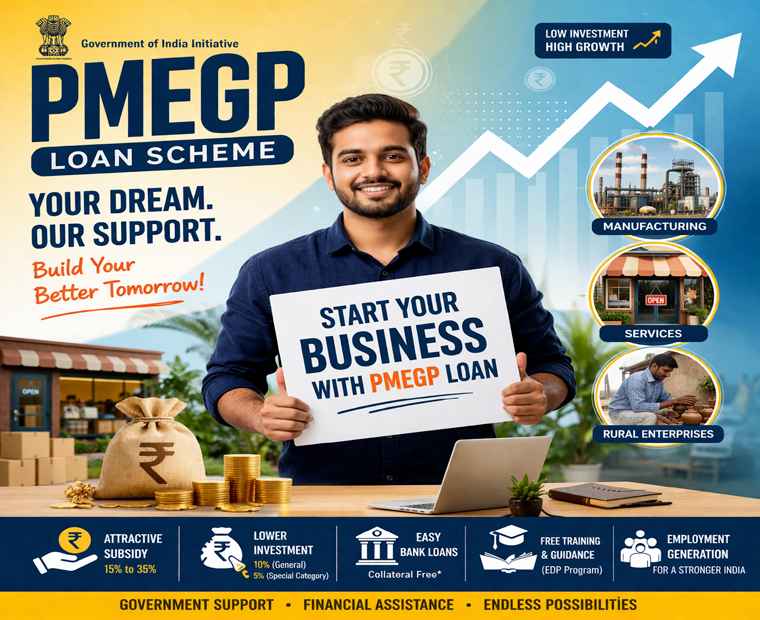
PMEGP Loan Scheme: Beginning something new takes effort, particularly if money is tight. Still, through the Prime Minister’s Employment Generation Programme (PMEGP), hopeful founders might see plans come alive. Backed by the government, this path offers monetary aid while encouraging people everywhere to build work for themselves.
This guide breaks down who qualifies for a PMEGP loan along with what makes it stand out, helping you weigh if it fits your needs. What matters most shows up clearly when looking at access rules paired with real benefits. Details unfold simply once you see how requirements link to outcomes. Clarity comes from matching personal goals to program traits. Each point builds quietly toward understanding without pushing any choice.
About PMEGP Loan
Aiming to boost job creation, The Prime Minister’s Employment Generation Programme runs through loans paired with subsidies. Backed by the Khadi and Village Industries Commission, it operates under the Ministry of Micro, Small and Medium Enterprises (MSME). Instead of just funding, it encourages self-employment via micro-enterprises across towns and villages alike. Support reaches new ventures that might otherwise struggle to begin.
PMEGP Loan Eligibility Criteria
Before applying, it is important to understand whether you meet the required eligibility conditions.
1. Age Requirement
To getting PMEGP Loan, the applicant must be at least 18 years old.
2. Educational Qualification
- For projects above Rs.10 lakh (Manufacturing) and Rs.5 lakh (Service sector),
applicants should have passed at least Class 8. - However, for smaller projects, no formal education is required.
3. Eligible Beneficiary
The scheme is open to a wide range of individuals and groups, including:
- Individuals (General, SC,ST, OBC & Women).
- Self-Help Groups (SHGs).
- Charitable Trusts.
- Registered Institutions.
- Cooperative Societies.
4. New Business Only
Importantly, PMEGP supports New Projects only. Existing businesses are not eligible.
5. Income Limit
There is No upper income limit, which makes this scheme accessible to many aspiring entrepreneurs.
6. Project Cost Limit
- Manufacturing sector: up to Rs.50 lakh.
- Service sector: Up to Rs.20 lakh.
PMEGP Loan Advantages
Now that you know who can apply, let’s explore the benefits that make PMEGP highly attractive.
1. Subsidy Benefit: One of the biggest advantages is the Government subsidy, which reduces the loan burden:
- General category: 15%–25% subsidy.
- Special categories: 25%–35% subsidy (Women).
This means you repay only a part of the total loan amount.
2. Low Initial Investment: Unlike traditional business loans, PMEGP requires only a small contribution:
- General category: 10% own contribution.
- Special category: 5% own contribution.
Therefore, even individuals with limited savings can start a business.
3. Encourages Self-Employment: The scheme is designed to promote Entrepreneurship, especially in rural areas. It helps reduce unemployment and supports local economic growth.
4. Wide Range of Business Options: Another key advantage is flexibility. You can start various businesses such as:
- Manufacturing units.
- Service-based businesses.
- Small industries and rural enterprises.
However, certain activities (like tobacco or alcohol-related businesses) are not allowed.
5. Bank Loan Support: Loans under PMEGP are provided through nationalized banks, cooperative banks, and regional rural banks. This ensures easy access to finance with proper guidance.
6. Skill Development & Training: Before starting the business, beneficiaries receive Entrepreneurship Development Programme (EDP) training, which helps improve business management skills.
7. Supports Rural & Urban Areas: Whether you live in a Village or a City, PMEGP supports both areas equally, making it inclusive and beneficial for all.
PMEGP Loan – Application Process
Applying for the PMEGP loan is simple if you follow the correct steps.
Step 1: Visit Official Portal First, go to the official PMEGP e-portal managed by the Khadi and Village Industries Commission.
Step 2: Online Registration
Next, fill out the online application form with details like:
- Name and contact details
- Aadhaar number
- Project details
- Bank preference
Step 3: Upload Required Documents
After that, upload the necessary documents such as:
- Aadhaar Card
- Educational certificates (if required)
- Project report
- Caste certificate (if applicable)
Step 4: Application Scrutiny
Then, your application will be reviewed by the District Level Task Force Committee (DLTFC).
Step 5: Bank Approval
Once approved, the application is forwarded to the bank for loan sanction.
Step 6: EDP Training
Before loan disbursement, you must complete Entrepreneurship Development Programme (EDP) training.
Step 7: Loan Disbursement
Finally the bank releases the loan amount, and your business journey begins.
Starting a business might feel tough in the beginning – yet the PMEGP loan plan makes it much easier to move forward. Thanks to straightforward entry rules, plus generous subsidies, putting money down feels less stressful. Because individuals need to spend so little from their own pocket, newcomers find it simpler to begin without hesitation.
What stands out is how the program does more than provide money. Support comes through hands-on learning, which shapes skills step by step. Success grows when people learn to plan carefully, not rush ahead. Towns see benefits just like villages do – opportunity spreads without favor. Jobs appear where they’re needed most, lifting communities quietly. Strength builds from steady effort, not big promises. Growth sticks when it starts close to home.
If starting something new matters to you, PMEGP offers steady backing through official support – making it stand out among options. A solid concept, matched with careful steps under this plan, slowly builds what once felt like just an idea.

